Cortometraje Mexicano
Director – Antonio Galicia
Corto Buenísimo

En Pruebas. Para compartir nuestra navegación
Cortometraje Mexicano
Director – Antonio Galicia
Corto Buenísimo
Ya he hablado anteriormente de ManageWP, un gestor integrado de sitios WordPress, pero este sistema adolecía de un problema para algunos, el hecho de que es un servicio que tienes que usar en un servidor externo, no lo puedes instalar donde tu quieras.
Pues bien, ya tenemos una opción, esta vez si alojable en tu propio servidor.
Estoy hablando de InfiniteWP, un software descargable, que no es un plugin WordPress, desde el que puedes administrar tantas instalaciones de WordPress como quieras.
Además, es un software gratuito que, en su actual versión básica inicial permite lo siguiente:
Como puedes comprobar, tienes algunas de las configuraciones premium de ManageWP de manera gratuita en este caso, lo que lo convierte en una muy buena opción.
Ahora bien, hay otras herramientas que no son gratuitas y que aún no se sabe el precio, a saber …
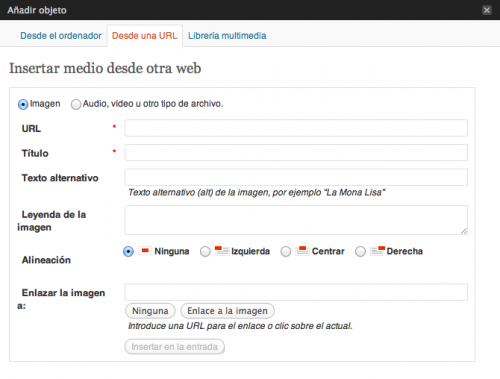
Uno de los malos usos del cargador de imágenes, que yo nunca recomiendo, es “Insertar medio desde URL“, y no lo recomiendo por varios motivos, todos importantes a mi modo de ver.
Los principales motivos por los que no es recomendable usar NUNCA este modo de añadir medios a nuestro WordPress son estos:
Uno de los lanzamientos más esperados de esta temporada de invierno es, sin duda alguna, el nuevo proyecto de Kim Dotcom: Mega. Este nuevo proyecto del fundador de Megaupload, que se estrenará el próximo 19 de enero, tiene como objetivo ofrecernos un servicio de almacenamiento en la nube con el que guardar nuestros archivos y compartirlos con otros usuarios poniendo un especial énfasis en la seguridad. Con la idea de ir abriendo boca, Dotcom ha decidido compartir, a través de Twitter, tres imágenes que nos muestran algunos detalles de lo que está por llegar.
Kim Dotcom muestra algunas imágenes del nuevo Mega « ALT1040.
Educación en nuevas tecnologías.
El gran Juan García @blogoff nos cuenta casos prácticos de su práctica de formación de chavales en el uso seguro y responsables de las nuevas tecnologías.
1. Tenemos la generación más preparada para las nuevas tecnologías y nos lo hemos currado para joderla” @blogoff
2. Datos de @blogoff sobre “nativos digitales”: 60% no saben que Tuenti está en Madrid, 80% no saben que Google indexa su foto Twitter. #FIMP Via @rafamerino
3. Debes en la #educación digital: seguridad informática, legalidad, reputación digital y selección de contenidos según @blogoff. Vía @_juancoamado
4. Para un nativo digital nuevas tecnológias y redes sociales siempre han existido. Eso no significa que sepan usarlas adecuadamente. #FIMP Vía @jmmerlo
Yoriento – Orientacion Profesional, Coaching, Empleo, Productividad y Networking.
Watching a particularly beautiful movie of the sun helps show how the lines between science and art can sometimes blur. But there is more to the connection between the two disciplines: science and art techniques are often quite similar, indeed one may inform the other or be improved based on lessons from the other arena. One such case is a technique known as a «gradient filter» — recognizable to many people as an option available on a photo-editing program. Gradients are, in fact, a mathematical description that highlights the places of greatest physical change in space.
A gradient filter, in turn, enhances places of contrast, making them all the more obviously different, a useful tool when adjusting photos. Scientists, too, use gradient filters to enhance contrast, using them to accentuate fine structures that might otherwise be lost in the background noise. On the sun, for example, scientists wish to study a phenomenon known as coronal loops, which are giant arcs of solar material constrained to travel along that particular path by the magnetic fields in the sun’s atmosphere. Observations of the loops, which can be more or less tangled and complex during different phases of the sun’s 11-year activity cycle, can help researchers understand what’s happening with the sun’s complex magnetic fields, fields that can also power great eruptions on the sun such as solar flares or coronal mass ejections.
The images here show an unfiltered image from the sun next to one that has been processed using a gradient filter. Note how the coronal loops are sharp and defined, making them all the more easy to study. On the other hand, gradients also make great art. Watch the movie to see how the sharp loops on the sun next to the more fuzzy areas in the lower solar atmosphere provide a dazzling show.
This video is public domain and can be downloaded at: http://svs.gsfc.nasa.gov/goto?11112
Like our videos? Subscribe to NASA’s Goddard Shorts HD podcast:
http://svs.gsfc.nasa.gov/vis/iTunes/f0004_index.html
Or find NASA Goddard Space Flight Center on Facebook:
http://www.facebook.com/NASA.GSFC
Or find us on Twitter:
http://twitter.com/NASAGoddard
Social Media Monitor for Law Enforcement.
This thin-client solution (no software to download) allows you to monitor Twitter for specific keywords and individual user activity. Simply type in your search terms and watch all the relevant Tweets stack up, in snapshot views or in real-time.
With the Social Media Monitor, you can also identify and track individuals YOU want to target. Whether you know who you want to follow, or you identify someone based on incoming Tweets, it’s easy to flag them and watch all their activity.
Best of all, real-time results can be geo-located, letting you see exactly where they originated. And you can save queries and archive and export the results, so you don’t have to re-build your searches again and again.
And when it comes time to analyze all that real-time content, a simple upgrade to our Deep Web Silo Services will let you store, slice, and dice Social Media content for the actionable intelligence you need. Click here to request a free demo of the Social Media Monitor.
View BrightPlanet’s Social Media Monitor Digital Brochure.
Toma La Tele nace a finales de marzo de 2012 por iniciativa de un grupo de personas provenientes de diversas asambleas populares, así como de colectivos relacionados con la información crítica y reflexiva, como Carabanchel, la Guindalera, la Conce, Arganzuela, Audivisol, TeleK, Madrid15M o Ágora Sol.

Por un lado pretende servir de plataforma audiovisual a todas las asambleas y colectivos que quieran participar en el proyecto mediante una web colectiva (www.tomalatele.tv), en la cual no existe ninguna gestión centralizada ni ningún filtro aparte de las cuestiones meramente legales (la protección de derechos de autor cuya vulneración pueda suponer el cierre la web). Dicho de otra forma: cualquier asamblea o colectivo puede disponer de su propia cuenta en Toma la Tele para subir, embeber en argot, las piezas audiovisuales que considere de interés.